New global estimates reveal 258 million children affected by crises as learning losses threaten an entire generation
Canada NewsWire
GENEVA, June 23, 2026
Education Cannot Wait launches new report showing that educational needs are highly concentrated in the world's most severe crises: nearly 80% of all out-of-school crisis-affected children live in just 20 countries
GENEVA, June 23, 2026 /CNW/ -- A new report released today by Education Cannot Wait (ECW), the global fund for education in crises in the United Nations, estimates that 258 million school-aged children and adolescents now have their education affected by crises worldwide. Of these, 93 million are entirely out of school, while millions more remain enrolled but struggle to learn under conditions that undermine their progress and increase their risk of dropping out. The new study finds that educational needs are highly concentrated: of the 182 million crisis-affected children living in the world's 20 most severe crisis contexts, 74 million are out of school – accounting for nearly 80% of all out-of-school crisis-affected children identified in the study.
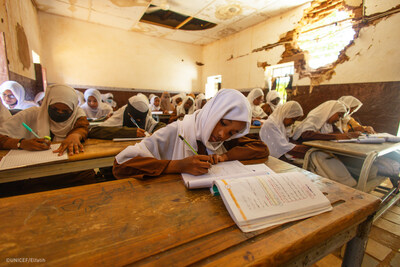
The report Breaking Barriers: Understanding Educational Exclusion in Crises reveals a crisis that extends far beyond access to education alone. Across many crisis-affected contexts, children are falling behind in acquiring foundational skills, with learning gaps widening as they progress through school. For too many, a learning crisis in the early grades becomes an access crisis in adolescence – leading to exclusion at precisely the moment education matters most. The findings provide the clearest picture yet of where educational needs are greatest and where investments can have the greatest impact.
"Support for education in crises is the insurance policy families, governments and donors need to protect their long-term investments in education and economic opportunity. The evidence is clear: conflict and climate change are rolling back hard-won gains in education. We are calling out the biggest emergency in education. The world's 20 most severe crisis contexts are home to 74 million out-of-school crisis-affected children – nearly 80% of all out-of-school crisis-affected children identified in this study. These findings show us where needs are greatest and where investments can have the greatest impact. Now is the time to invest in the futures of crisis-affected children," said ECW Director Maysa Jalbout.
Key findings from the report include:
- A growing crisis: The number of children affected by crises has increased by 21 million in just 18 months, reaching an estimated 258 million worldwide.
- Educational needs are highly concentrated: The 20 countries classified at the highest crisis severity level are home to 182 million crisis-affected children and 74 million out-of-school crisis-affected children, representing nearly 80% of all out-of-school crisis-affected children.
- Exclusion is deeply unequal: Refugees, internally displaced children, children with disabilities and girls face disproportionately high barriers to education.
- Families still prioritise education: While financial barriers and conflict-related school closures account for nearly 80% of school withdrawal cases, the findings underscore that families continue to prioritise education and want their children in school.
- A learning crisis in early grades can become an access crisis in adolescence: Less than 1 in 10 children demonstrate foundational reading skills in the early grades, with learning gaps contributing to higher dropout rates as children progress through school.
- Displacement creates lasting educational disadvantages: Analysis from Burkina Faso, the Central African Republic, the Democratic Republic of the Congo, Mali and Somalia shows that displaced children face lower promotion rates, slower progression and overage rates 5–15 percentage points higher than their non-displaced peers.
- Conflict is associated with deeper and more persistent learning deficits: Children living in crisis-affected countries face some of the lowest learning outcomes observed in the study. By Grade 6, reading proficiency reaches just 30% in conflict-affected countries, compared with 47% in countries affected primarily by socioeconomic crises and 63% in countries affected primarily by natural disasters.
The findings point to a crisis that is growing in scale, highly concentrated and deeply unequal. Educational exclusion is shaped by where children live, the type of crisis they face and whether they are displaced, living with a disability or otherwise marginalised. While the concentration of need creates opportunities for targeted action, the report makes clear that access alone is not enough. Effective responses must help children stay in school, learn, progress and successfully transition through education.
As the global fund for education in crises, ECW already invests in many of the countries highlighted in the report, working alongside governments, local organisations and strategic partners to reach children living at the intersection of armed conflict, displacement and climate shocks.
Since its inception, ECW and its partners have reached more than 14 million crisis-affected children and adolescents with quality education, protection and holistic support. Building on these results, ECW's Strategic Plan 2027–2030 aims to reach an additional 10 million girls and boys living in some of the world's most severe crises. Achieving this ambition will require sustained political commitment and US$600 million in new resources over the next four years.
The findings in the new report will help inform ECW's upcoming Hope Starts Here campaign, which will mobilise partnerships, advocacy and investments ahead of the Fund's High-Level Financing Conference in Geneva on 5 November. The campaign is built on a simple idea: hope begins wherever action takes place. From classrooms and communities to donor capitals and global decision-making forums, everyone has a role to play in helping children in crises learn and thrive.
Despite conflict, displacement and adversity, children and families continue to believe in the power of education. The world must match that determination with action. By investing in education today, the international community can help millions of crisis-affected children stay in school, acquire the skills they need to thrive and contribute to more peaceful, resilient and prosperous societies tomorrow.
Note to Editors
- Download the full Global Estimates Report
- Broll and photos
- Social media kit
- Register for the Global Estimates Report webinar (25 June 2026, 14:00–15:00 CET).
About Education Cannot Wait:
Education Cannot Wait (ECW) is the global fund for education in crises. The Fund provides rapid, flexible funding to locally-led education responses that protect learning for refugee, internally displaced and other children, while strengthening systems to sustain learning and resilience in fragile and conflict-affected contexts. ECW works with governments, public and private funders, UN agencies, civil society organisations, and other humanitarian and development aid actors so that no child is left behind.
As global crises intensify and the education financing gap widens, ECW calls on public and private sector partners to scale up investments so millions more crisis-affected girls and boys can learn and rebuild their futures.
Additional information available at: www.educationcannotwait.org
 View original content to download multimedia:https://www.prnewswire.com/news-releases/new-global-estimates-reveal-258-million-children-affected-by-crises-as-learning-losses-threaten-an-entire-generation-302807444.html
SOURCE Education Cannot Wait

